
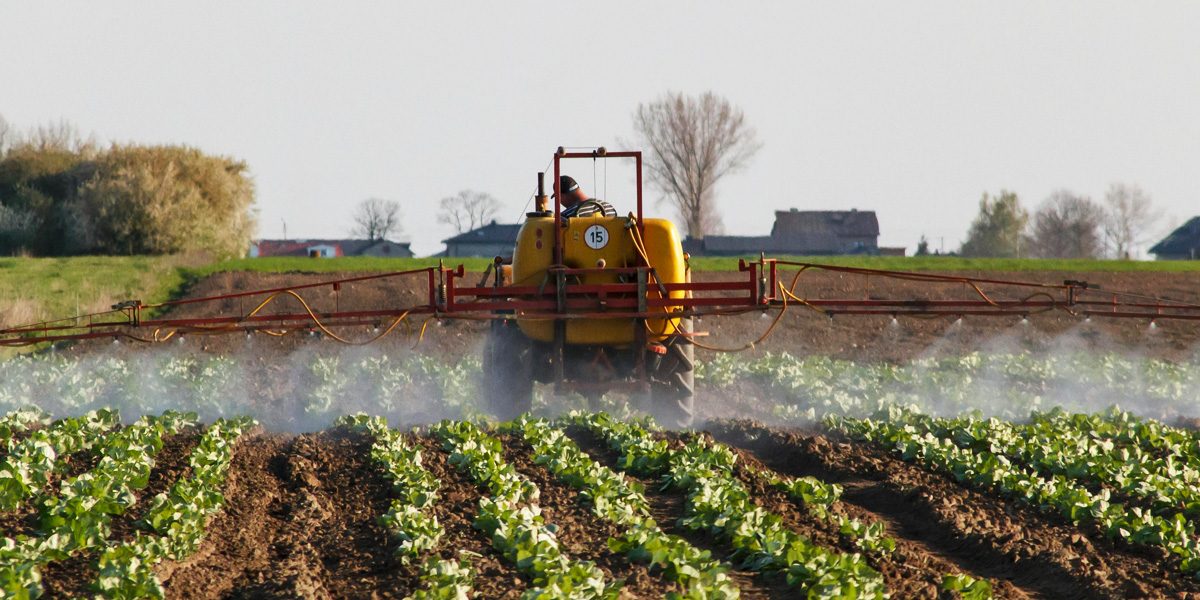

In my search for a house in a rural area, I investigated whether there were any fields nearby where poison is sprayed. Because living outside, besides peace and quiet and space, also brings with it concerns about agricultural poisons blowing and ending up in your garden, in your home.
Pesticides are toxins used to control fungi, insects and "weeds," for example, and it is well established that many of them are not harmless to humans either.
For local residents, this poses health risks. What are the consequences for you?
Airborne ventilation
When pesticides are sprayed, the idea is that they end up in the field. Some of the fine droplets also end up outside the field via the air. This is called drift.
This is also how pesticides end up in your home. Studies have shown that pesticides can be found even in bedrooms near sprayed fields. The highest number of pesticides and the highest concentration of pesticides outside sprayed fields is found in house dust.1 But perhaps the most important concern is that it's in the air you breathe.
How much drift occurs and how far it extends depends on wind strength and direction, the spraying method and the composition of the agent. The finer the droplets, the stronger the wind, and the more volatile the agent, the farther it spreads from the intended area.
Concerns about health effects
As a local resident, it is natural to be concerned about the potential consequences of inhaling these substances and depositing them in your environment.
Although acute poisoning (e.g., from a single high-dose exposure) is rare, there is strong evidence of adverse health effects from long-term, low-level exposure. For example, science clearly links pesticides to asthma in children and adolescents.2 Pesticides also appear to cause other health problems, including cancer, Alzheimer's, Parkinson's, ALS, bronchitis, infertility, birth defects, ADHD, autism, diabetes and obesity.3
But science does not yet have all the answers and is still working hard to identify the precise long-term effects, for example with the EU-funded SPRINT study. Exactly how much risk exposure poses depends, among other things, on the specific substances, the duration of exposure and individual sensitivity to it.
Other conditions
Biggest culprits are herbicides (against "weeds") and insecticides (against insects), the strongest links of which have been shown to cause human health harm.4
Thus, the insecticides most commonly used worldwide affect - organophosphates - the nervous system and can lead to symptoms such as headaches, nausea, dizziness, muscle weakness and breathing problems.5 Prolonged or high exposure is associated with many of the conditions I mentioned above.
These substances are used in the cultivation of various crops, including potatoes, cereals, fruits, and certainly the intensively sprayed bulb crops.
Rules and practice
The Netherlands has rules to limit exposure, such as spray-free zones. But these provide insufficient protection. A buffer strip of 50 meters is common, while the RIVM published research in 2019 showing that most and highest concentration of pesticide residues precipitate within 250 meters between fields and sensitive destinations such as homes.6 Judges, meanwhile, in their rulings in cases between growers and local residents, therefore maintain 250 meters as a safe distance.
But even that distance may be insufficient, as pesticides can spread for miles through drift.
Moreover, the question is whether the rules are always observed and enforced. In practice, the rules often seem to fall short of properly protecting local residents, especially vulnerable groups.
Precautionary obligations
The debate over pesticides is stirring up a lot because of the conflicting interests: the desire of farmers to protect their crops and generate an income, the right of local residents to a healthy and safe environment and food security.
The precautionary principle dictates that health protection takes precedence when different interests conflict. European and national laws impose precautionary obligations on governments not to authorize substances if there are reasonable doubts about their safety. At present, this obligation is not being adequately met.
Fortunately, if drugs that cause harm are still authorized and placed on the market, there are legal options. Although these require courage and financial resources. The last hurdle is the easiest to take.
Conclusion
Worried about your exposure to pesticides?
Then document when and how often spraying occurs in your area. Note wind direction, weather conditions and odor. Try to find out what agents are being used. Take samples of dust, vegetables from your own garden, take photos and videos, keep a log of health complaints and report to relevant agencies such as the GGD, environmental service or municipality and NVWA.
This information may be the deciding factor if you later want to take legal action because you believe your health (or that of your family) is being harmed by pesticide exposure.
Do you have questions about this blog or about liability for health damage caused by environmental factors? Please feel free to contact Victor Vandersmissen.
1 Silva V, Gai L, Harkes P, Tan G, Ritsema CJ, Alcon F, Contreras J, Abrantes N, Campos I, Baldi I, Bureau M, Christ F, Mandrioli D, Sgargi D, Pasković I, Polić Pasković M, Glavan M, Hofman J, Huerta Lwanga E, Norgaard T, Bílková Z, Osman R, Khurshid C, Navarro I, de la Torre A, Sanz P, Ángeles Martínez M, Dias J, Mol H, Gort G, Martins Figueiredo D, Scheepers PTJ, Schlünssen V, Vested A, Alaoui A, Geissen V. Pesticide residues with hazard classifications relevant to non-target species including humans are omnipresent in the environment and farmer residences. Environ Int. 2023 Nov;181:108280. doi: 10.1016/j.envint.2023.108280. Epub 2023 Oct 30. PMID: 37924602.
2 Rodrigues MB et al, Association between exposure to pesticides and allergic diseases in children and adolescents: a systematic review with meta-analysis. J Pediatr (Rio J). 2022 Nov-Dec;98(6):551-564. doi: 10.1016/j.jped.2021.10.007. Epub 2022 Jan 1. PMID: 34982974; PMCID: PMC9617275.
3 Mostafalou S, Abdollahi M. Pesticides: an update of human exposure and toxicity. Arch Toxicol. 2017 Feb;91(2):549-599. doi: 10.1007/s00204-016-1849-x. Epub 2016 Oct 8. PMID: 27722929.
4 Ibid.
5 Netherlands Center for Occupational Diseases,Fact sheet: sick from pesticides[online], available from:https://www.beroepsziekten.nl/sites/default/files/factsheets/Factsheet-Ziek-door-Pesticiden.pdf, accessed May 6, 2025.
6 RIVM, Pesticides and residents 2019.