


Skip to content
Beer logo
  • Personal injury
  • Mass tort
  • Current affairs
  • Careers at
  • Our team
  • Contact
  • Nederlands
  • Search
  • Personal injury
  • Mass tort
  • Current affairs
  • Careers at
  • Our team
  • Contact
  • Nederlands
  • Search
EN
EN NL

Blog

Move to multi-purpose building

  • June 23, 2021
Bojan Dekker

Beer advocaten moves to traditional old Amsterdam building on Prinsengracht: 'The building facilitates the way we want to work together' - Letselschade.NU - All about personal injury

More blogs

Unwanted Guests in the Home: Mold

October 8, 2026

Mold in homes is a major problem. Recent figures from Statistics Netherlands (CBS) show that in 2024, one in five households experienced moisture or mold in their homes. Earlier, our colleague Mildred Brun wrote about Awaab Ishak, who was exposed to mold for years. His situation painfully illustrates that mold poses serious health risks, especially for children. This raises the question of what responsibility landlords bear for their tenants“ living environment. In this blog, we’ll examine how mold gets into your home and the potential health risks it poses. We’ll then describe the legal steps you can take to resolve the problem.  How does mold develop in a home? Mold grows in damp places because water is necessary for its metabolism, enzyme activity, and structural integrity. Mold growth is therefore linked to the availability of moisture, expressed as relative humidity (RH) and the local moisture conditions of the surface. In general, a relative humidity of more than 70% is a prerequisite for mold growth. Mold can grow in homes on materials that both retain moisture and contain organic matter. Think of places where excessive moisture is present for extended periods, for example due to condensation, leaks, or insufficient ventilation. Porous, organic building materials such as wood, plaster, paper, cardboard, and textiles pose the greatest risk, but due to contamination with dust, grease, and skin cells, growth is also possible on materials such as concrete, stone, stucco, paint, plastic, and sealant.   Mold does not so much grow on the material itself, but rather because of the material in combination with moisture and contaminants. Any surface that remains damp for an extended period and provides a food source can develop mold growth in the home. How are you exposed to mold?   Mold byproducts, such as spores, fragments of hyphae, and volatile compounds released by the mold, end up in the air. This is caused by air currents, temperature differences, or movement—for example, during cleaning. People come into contact with mold through these airborne particles.   Why is mold so dangerous? Because people inhale airborne particles, mold poses a particular risk to the respiratory tract and lungs. Depending on its size, mold can penetrate as far as the small airways and alveoli. This results in direct irritation of the mucous membrane, accompanied by swelling, increased mucus production, and shortness of breath due to narrowing of the airways (bronchoconstriction). Certain toxic substances produced by mold can even directly damage the mucous membranes. Most health problems arise because the immune system reacts to these substances. Common consequences include the development or worsening of allergic asthma, chronic respiratory conditions (bronchitis or COPD), and allergic rhinitis (”mold-induced rhinitis”). In rare cases, the alveoli become chronically inflamed (hypersensitivity pneumonitis), which can lead to permanent lung damage due to the formation of scar tissue in the lungs.   Scientific research shows that exposure to moisture problems and mold in homes is associated with a higher risk of respiratory symptoms. This is especially true for children, but also applies to adults. Some studies have found that people living in damp or moldy buildings are up to 75% more likely to experience respiratory symptoms and asthma-related problems. In 2009, the World Health Organization (WHO) issued guidance on the dangers of mold. According to the WHO, mold growth in homes is a proven risk factor for respiratory diseases, which is why preventive measures are recommended to avoid moisture problems and mold growth. From certain
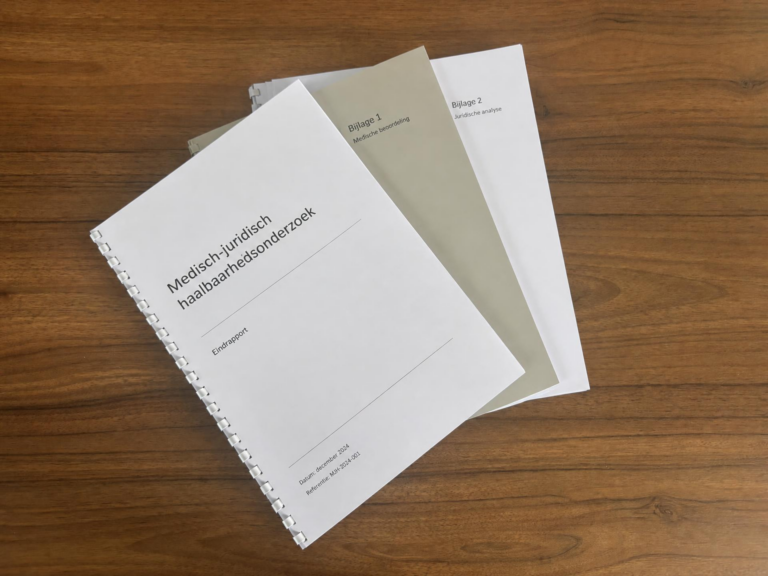
Medical Liability: The Medical-Legal Feasibility Study

September 24, 2026

If you suspect medical malpractice and want compensation, you must first prove that a mistake was actually made. That isn’t always easy. The difference between a complication and actual medical malpractice is far from always clear at first glance. At Beer advocaten, you can request a medical-legal feasibility assessment. This will give you more clarity on the feasibility of your medical liability case. How does the assessment work? One of our in-house medical advisors reviews the medical information. At the same time, your attorney will do the same from a legal perspective. The medical advisor explains to the attorney what happened during your treatment and what may not have been done correctly. Based on that advice and the legal analysis, you’ll receive a medical-legal feasibility assessment. What might the assessment entail? Sometimes the opinion is positive. In that case, you can choose to have a notice of liability drafted. Sometimes, it’s recommended to let the matter rest. There can be various reasons for this. A negative opinion is, of course, not what you hoped to hear, but it can also provide clarity and closure. A positive recommendation is no guarantee Once the notice of liability has been sent, the other party—usually an insurer—will have its own view of the case. The insurer will typically also consult a medical advisor. Our views may align or differ. If the latter is the case, we often enter the next phase to determine who is ‘right’: the expert report. An independent expert will then review all available (medical) information once more and write a report. Based on that report, there is usually greater clarity regarding the medical treatment and whether a medical error was made. What are the costs? You are initially responsible for paying the costs of the feasibility study yourself. The exact cost of this investigation and consultation depends on the complexity of the case and the size of the medical file. A cost estimate will be provided on a case-by-case basis. If liability is acknowledged, I will attempt to recover the costs from the insurer. Do you suspect a medical error? I’d be happy to discuss your options with you. Mr. Van de Velde is an attorney at Beer advocaten and represents exclusively victims and their surviving relatives.

Medical Malpractice Cases: Evidence

September 21, 2026

A medical error can change your life forever, but how do you legally prove that it was actually an error? In this blog, I’ll discuss how you, as a patient or a patient’s next of kin, can prove that a healthcare provider made a medical error. The Medical Record Is Key In a medical malpractice case, the medical record serves as the foundation. It details what was done, decided, and assessed, and when. At least, that’s how it should be. In practice, patients often have a different recollection of the treatment than what’s in the records. Those recollections are also important, but they’re always weighed against what’s in the records. Furthermore, great weight is given to the statements made by the doctor or healthcare provider regarding these matters, including by the judge. What if the records are inaccurate? This is where it gets complicated. Medical records are often incomplete. Consultations that weren’t noted, symptoms you did report but that aren’t mentioned anywhere, appointments that weren’t documented. It can also happen that something is recorded that, in your opinion, simply doesn’t match what was actually said or done. That can feel very unfair. As a patient, you’re often at a 1-0 disadvantage. So how do you prove that you’re right? In that case, you’ll need to find another way to demonstrate that your version of events is accurate. This can be done, for example, through witness statements, messages you sent at the time, notes you kept yourself, log data, or other means. But to be honest, that’s usually not easy. If the medical record is flawed or incomplete, the burden of proof on you is quite heavy. That doesn’t mean the case is hopeless, but it’s important to keep this in mind. What I can do for you I help clients assess whether there is sufficient evidence for a legally viable case. This begins with a critical analysis of the medical record: what is in it, what is missing, and what does that mean? Sometimes it becomes clear early on that the evidence is strong or that the medical record aligns with what the client has stated. Sometimes it isn’t; in that case, I’ll advise you on the options still available to strengthen the evidence and whether it’s worth pursuing those options. Would you like to know if you have sufficient evidence for a legally viable medical malpractice case? If so, you can have us prepare a medical-legal feasibility study for you. You can read more about this in the following blog post: ‘Medical Malpractice Cases: Medical-Legal Feasibility Study.’ Do you suspect medical malpractice? I’d be happy to discuss your options with you. Mr. Van de Velde is an attorney at Beer advocaten and represents exclusively victims and their surviving relatives.  

More blogs

Prinsengracht 515
1016 HR Amsterdam
info@beeradvocaten.nl
+31 20 67 32 199

Linkedin
  • Personal injury
  • All about personal injury
  • Frequently Asked Questions
  • Tell us your story
  • Personal injury
  • All about personal injury
  • Frequently Asked Questions
  • Tell us your story
  • Mass tort
  • All about mass tort
  • Frequently Asked Questions
  • Make an appointment
  • Mass tort
  • All about mass tort
  • Frequently Asked Questions
  • Make an appointment
  • Current affairs
  • Our team
  • Careers at
  • Contact
  • Current affairs
  • Our team
  • Careers at
  • Contact

Privacy Statement | General conditions | Complaint Resolution

 | Revoke consent for Google Analytics |
Copyright Beer advocaten 2026