
Last March, a Los Angeles jury reached a historic verdict: it held Meta and Google liable for a woman's social media addiction. The judge awarded damages totaling six million dollars, three million of which was compensation for the harm done and three million punitive damages (intended to punish the defendant), because the jury found that both companies had acted with malicious intent. Meta was responsible for seventy percent of the damages, Google for thirty percent.[1] It is the first time a jury in the United States has awarded this type of damages to an individual user in a liability suit against a social media company.
How does social media make us addicted?
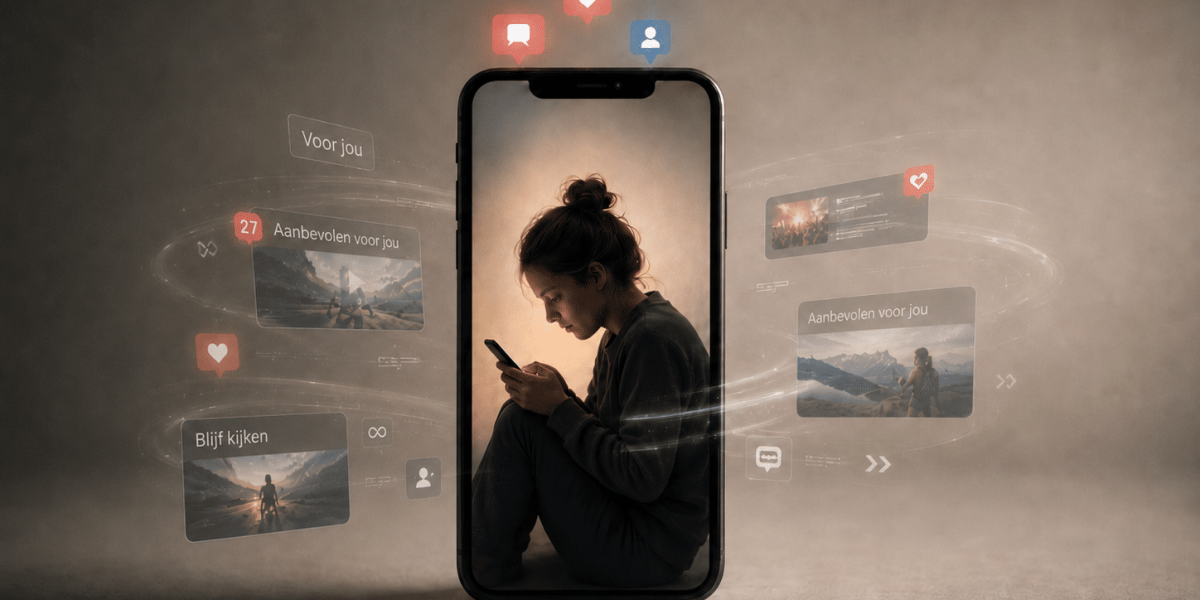
That social media addiction exists is now widely recognized. Platforms are built to keep users glued to the screen for as long as possible: infinite scroll, notifications, likes: all design incentives and algorithmic recommendations that constantly cater to human tendencies.
Research by Bits of Freedom, published in March 2026 and funded by the Creative Industry Stimulation Fund, mapped those mechanisms. The researchers identified 19 specific design types that facilitate online addiction, including endless scroll, gamification, social pressure and temporary content.[2] Bits of Freedom concluded that these are not accidental side effects, but all deliberate choices by these social media platforms. Everything is set up with only one goal: addiction.
Social media addiction is not yet recognized as a mental illness in the Netherlands.[3] That doesn't make the phenomenon any less real. That social media can cause damage is at least already apparent in the Netherlands. Newcom's National Social Media Research 2026, conducted among more than six thousand respondents, shows that 2.6 million Dutch people feel less happy because of social media. 5.5 million are trying to reduce their use. Newcom sees a clear connection: more intensive use goes hand in hand with lower physical and mental well-being and greater demand for care.[4]
Is there any legal recourse against these platforms in the Netherlands as well?
The U.S. ruling has no direct effect in the Netherlands. But it illustrates something that will also become legally relevant here: that platforms can be held responsible for the damage their products cause.
There is a legal basis for liability in Europe. Since Feb. 17, 2024, the Digital Services Act (DSA) in effect. This regulation requires large platforms to identify and mitigate the risks of their own algorithms. The AI Act, many of whose rules go into effect on Aug. 2, 2026, additionally imposes obligations on systems that generate or recommend content. Further regulation is also expected from the upcoming European Digital Fairness Act in this context. Bits of Freedom suggests that this regulation should explicitly regulate addictive design, with an emphasis on autonomy and consent as a starting point. Consider, for example, the possibility for users to turn off addictive features.
The first results of this legislation are already visible. On Feb. 6, 2026, the European Commission made a preliminary determination that TikTok, with its addictive design, may violate the DSA. In doing so, the Commission cited exactly the mechanisms that have long been criticized in the public debate: infinite scroll, autoplay, push notifications and a highly personalized recommendation system. According to the Commission, TikTok should have better investigated and mitigated how these features could lead to compulsive use and harm to users' physical and mental well-being, especially with regard to minors and vulnerable adults.
All this creates, also in the Netherlands, legal points of departure for liability. If a platform is obliged to recognize and restrict addictive mechanisms, but fails to do so, a victim may be able to do something about it in a civil suit. European standards will be helpful in such proceedings to establish that social media platforms are acting unlawfully against their users. If a court reaches that conclusion, then the liable platform must compensate the user's damages.
So what should we in the Netherlands think about? Costs of psychological treatment as a result of addiction will be eligible for compensation. It is also possible to think of a sum in damages for the suffering inflicted on users or compensation because a user's social media addiction makes him work less, or unable to work at all. The six million dollars awarded by the jury in Los Angeles will not be reached soon, but in appropriate cases damages in the Netherlands can also be substantial.
Damages must be paid by the causative party
We have not yet seen a case like the one in Los Angeles in the Netherlands. But there are opportunities in the Netherlands as well. The DSA, enforcement by the European Commission and the announced Digital Fairness Act make it clear that platforms bear responsibility for the risks of their design choices. We are waiting for the first Dutch case where that responsibility is enforced through the courts.
If platforms make money from design choices that knowingly make users sick, the damage should not remain with those users, but should be at the expense and risk of the causer.
[1] https://nos.nl/artikel/2607819-jury-in-vs-stelt-meta-en-google-aansprakelijk-voor-socialemediaverslaving.
[2] Caroline Sinders and Dr. Romanye Gad el Rab, Exploratory study of Addicting Design., Bits of Freedom/Convocation Research + Design, March 2026
[3] According to the DSM-5 (Diagnostic and Statistical Manual of Mental Disorders, fifth edition), the leading international manual for classifying psychiatric disorders.
[4] North Limburg Business, ‘Social media in the Netherlands: growth continues, but worries and “headwinds” increase., northlimbburgbusiness.com.